- because of his profoundly sensitive, fresh and beautiful verse, by which, with comsummate skill, he has made his poetic thought, expressed in his own English words, a part of the literature of the West.
- 1861-1941
- Place of Birth: Calcutta, India
- Residence: India
- Biographical highlights:
- 1879 - Enrolled at University College, but recalled by father in 1880
- 1901 - Founded Santiniketan
- 1921 - Added a university at Santiniketan
- 1913 - Awarded Nobel Prize for Literature, becoming the first Asian to receive it
- 1915 - Knighted
- 1919 - Resigned knighthood after Amritsar Massacre, in protest of British policies
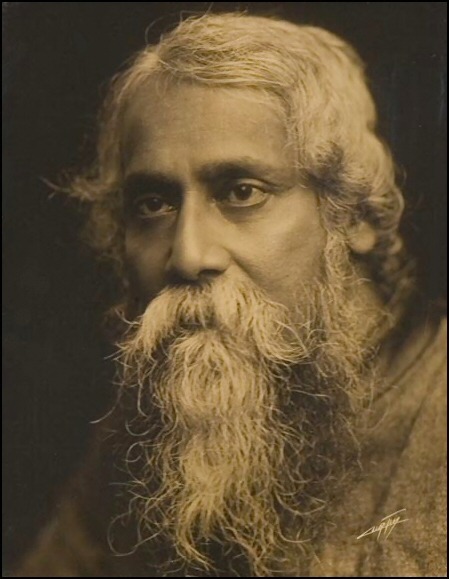 Rabindranath Tagore (Bengali: রবীন্দ্রনাথ ঠাকুর)α[›]β[›] (7 May 1861 – 7 August 1941),γ[›] sobriquet Gurudev,δ[›] was a Bengali polymath. As a poet, novelist, musician, and playwright, he reshaped Bengali literature and music in the late 19th and early 20th centuries. As author of Gitanjali and its "profoundly sensitive, fresh and beautiful verse",in 1913 being the first non-European to win the Nobel Prize in Literature,[2] Tagore was perhaps the most important literary figure of Bengali literature. He was a mesmerising representative of the Indian culture whose influence and popularity internationally perhaps could only be compared to that of Gandhi, whom Tagore named 'Mahatma' out of his deep admiration for him.
A Pirali Brahmin from Kolkata, Tagore was already writing poems at age eight. At age sixteen, he published his first substantial poetry under the pseudonym Bhanushingho ("Sun Lion")[8][9] and wrote his first short stories and dramas in 1877. Tagore denounced the British Raj and supported independence. His efforts endure in his vast canon and in the institution he founded, Visva-Bharati University.
Tagore modernised Bengali art by spurning rigid classical forms. His novels, stories, songs, dance-dramas, and essays spoke to political and personal topics. Gitanjali (Song Offerings), Gora (Fair-Faced), and Ghare-Baire (The Home and the World) are his best-known works, and his verse, short stories, and novels were acclaimed for their lyricism, colloquialism, naturalism, and contemplation. Tagore was perhaps the only litterateur who penned anthems of two countries: Bangladesh and India: Amar Shonar Bangla and Jana Gana Mana.
Stories
Ink illustration of a tousled-haired boy seated outside and holding a lance-stick and playing with a wheeled red toy horse; in the background, a large blue palanquin and tackle with a carrying pole projecting out of it.
A Nandalal Bose illustration for "The Hero", part of the 1913 Macmillan release of The Crescent Moon
The "Sadhana" period, 1891–1895, was among Tagore's most fecund, yielding more than half the stories contained in the three-volume Galpaguchchha, itself a group of eighty-four stories.[17] They reflect upon Tagore's surroundings, on modern and fashionable ideas, and on mind puzzles. Tagore associated his earliest stories, such as those of the "Sadhana" period, with an exuberance of vitality and spontaneity; these traits were cultivated by zamindar Tagore’s life in villages such as Patisar, Shajadpur, and Shilaida.[17] Seeing the common and the poor, he examined their lives with a depth and feeling singular in Indian literature up to that point.[77]
In "The Fruitseller from Kabul", Tagore speaks in first person as a town-dweller and novelist who chances upon the Afghani seller. He channels the longing of those trapped in mundane, hardscrabble Indian urban life, giving play to dreams of a different existence in the distant and wild mountains: "There were autumn mornings, the time of year when kings of old went forth to conquest; and I, never stirring from my little corner in Kolkata, would let my mind wander over the whole world. At the very name of another country, my heart would go out to it ... I would fall to weaving a network of dreams: the mountains, the glens, the forest .... ".[78] Many of the other Galpaguchchha stories were written in Tagore’s Sabuj Patra period (1914–1917; also named for one of Tagore's magazines).[17]
A warm-toned ink work, dominated by orange-red (foreground) and olive green (background wall) showing a shawl- and sari-clad woman with a young child, who holds a book, in her lap.
A 1913 illustration by Asit Kumar Haldar for "The Beginning", a prose-poem in The Crescent Moon
Tagore's Golpoguchchho (Bunch of Stories) remains among Bengali literature's most popular fictional works, providing subject matter for many successful films and theatrical plays. Satyajit Ray's film Charulata was based upon Tagore's controversial novella, Nastanirh (The Broken Nest). In Atithi (also made into a film), the young Brahmin boy Tarapada shares a boat ride with a village zamindar. The boy reveals that he has run away from home, only to wander around ever since. Taking pity, the zamindar adopts him and ultimately arranges his marriage to the zamindar's own daughter. However, the night before the wedding, Tarapada runs off—again. Strir Patra (The Letter from the Wife) is among Bengali literature's earliest depictions of the bold emancipation of women. The heroine Mrinal, the wife of a typical patriarchical Bengali middle class man, writes a letter while she is travelling (which constitutes the whole story). It details the pettiness of her life and struggles; she finally declares that she will not return to her husband's home with the statement Amio bachbo. Ei bachlum: "And I shall live. Here, I live".
Haimanti assails Hindu marriage and the dismal lifelessness of married Bengali women, hypocrisies plaguing the Indian middle classes, and how Haimanti, a sensitive young woman, must—due to her sensitiveness and free spirit—sacrifice her life. In the last passage, Tagore directly attacks the Hindu custom of glorifying Sita's attempted self-immolation as a means of appeasing her husband Rama's doubts. Musalmani Didi examines Hindu-Muslim tensions and, in many ways, embodies the essence of Tagore's humanism. Darpaharan exhibits Tagore's self-consciousness, describing a fey young man harboring literary ambitions. Though he loves his wife, he wishes to stifle her own literary career, deeming it unfeminine. Tagore himself, in his youth, seems to have harbored similar ideas about women. Darpaharan depicts the final humbling of the man as he acknowledges his wife's talents. As do many other Tagore stories, Jibito o Mrito equips Bengalis with a ubiquitous epigram: Kadombini moriya proman korilo she more nai—"Kadombini died, thereby proving that she hadn't".
Poetry
Tagore's poetry—which varied in style from classical formalism to the comic, visionary, and ecstatic—proceeds from a lineage established by 15th- and 16th-century Vaishnava poets. Tagore was awed by the mysticism of the rishi-authors who—including Vyasa—wrote the Upanishads, the Bhakti-Sufi mystic Kabir, and Ramprasad Sen.[79] Yet Tagore's poetry became most innovative and mature after his exposure to rural Bengal's folk music, which included Baul ballads—especially those of bard Lalon.[80][81] These—rediscovered and popularised by Tagore—resemble 19th-century Kartābhajā hymns that emphasize inward divinity and rebellion against religious and social orthodoxy.[82][83] During his Shilaidaha years, his poems took on a lyrical quality, speaking via the maner manus (the Bāuls' "man within the heart") or meditating upon the jivan devata ("living God within"). This figure thus sought connection with divinity through appeal to nature and the emotional interplay of human drama. Tagore used such techniques in his Bhānusiṃha poems (which chronicle the romance between Radha and Krishna), which he repeatedly revised over the course of seventy years.[84][85]
Tagore responded to the mostly crude emergence of modernism and realism in Bengali literature by writing experimental works in the 1930s.[86] Examples works include Africa and Camalia, which are among the better known of his latter poems. He occasionally wrote poems using Shadhu Bhasha (a Sanskritised dialect of Bengali); later, he began using Cholti Bhasha (a more popular dialect). Other notable works include Manasi, Sonar Tori (Golden Boat), Balaka (Wild Geese—the title being a metaphor for migrating souls),[87] and Purobi. Sonar Tori's most famous poem—dealing with the ephemeral nature of life and achievement—goes by the same name; hauntingly it ends: "শূন্য নদীর তীরে রহিনু পড়ি / যাহা ছিল লয়ে গেল সোনার তরী" ("Shunno nodir tire rohinu poŗi / Jaha chhilo loe gêlo shonar tori"—"all I had achieved was carried off on the golden boat—only I was left behind."). Internationally, Gitanjali (গীতাঞ্জলি) is Tagore's best-known collection, winning him his Nobel Prize.[88] Song VII (গীতাঞ্জলি 127) of Gitanjali:


|
|

Free-verse translation by Tagore (Gitanjali, verse VII):[89]
|
|
"Klanti" (Bengali: ক্লান্তি; "Fatigue"), the sixth poem in Gitanjali:
|
|
Tagore's poetry has been set to music by various composers, among them classical composer Arthur Shepherd's triptych for soprano and string quartet, as well as composer Garry Schyman's "Praan", an adaptation of Tagore's poem "Stream of Life" from Gitanjali. The latter was composed and recorded with vocals by Palbasha Siddique to accompany Internet celebrity Matt Harding's 2008 viral video.[90] In 1917 his words were translated adeptly and set to music by Richard Hageman (an Anglo- Dutch composer) to produce what is regarded as one of the finest art songs in the English language: Do not go my love (Ed.Schirmer NY 1917).

